
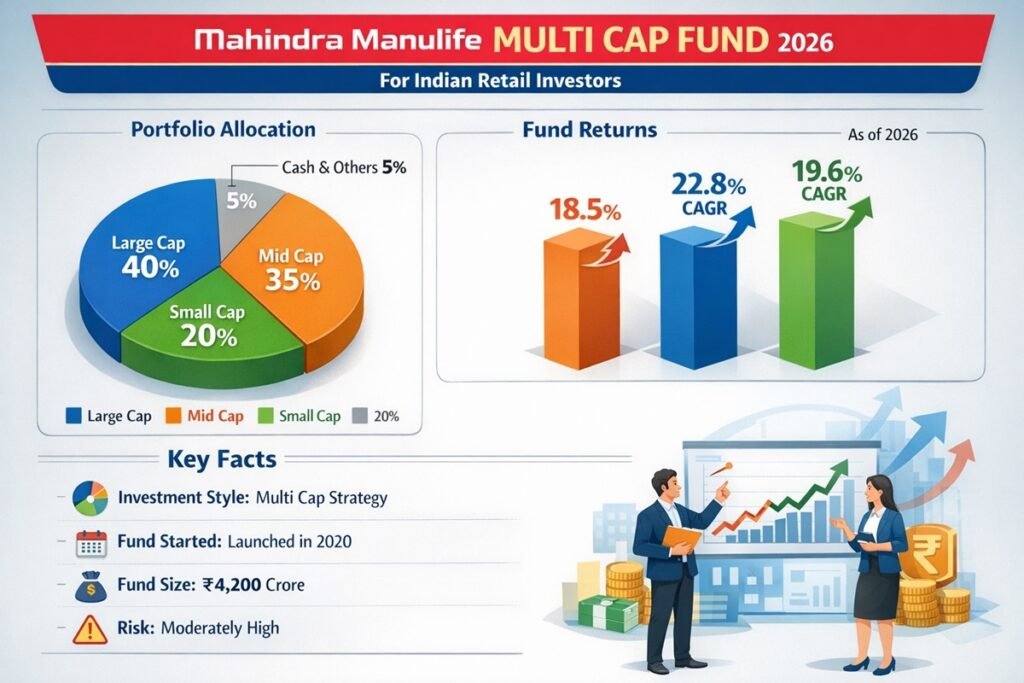
A complete review of Mahindra Manulife Multi Cap Fund covering its portfolio, 1, 3 and 5-year returns, expense ratio, risk profile, tax rules, and an honest verdict on whether it is worth investing in via SIP in 2026.
If you are searching for a mutual fund that spreads your money across large, mid, and small cap stocks in a single portfolio, the Mahindra Manulife Multi Cap Fund could be on your radar. This fund is managed by Mahindra Manulife Mutual Fund, a joint venture between the Mahindra Group and Manulife Investment Management.
It follows SEBI’s mandatory multi cap structure, which means your investment is diversified across all market segments. In this article, we will do a detailed Mahindra Manulife Multi Cap Fund review, covering its portfolio, returns, risks, and whether it deserves a place in your investment portfolio in 2026.
What is Mahindra Manulife Multi Cap Fund?
A multi cap fund is a type of equity mutual fund that is required by SEBI (Securities and Exchange Board of India) to invest a minimum of 25% each in large cap, mid cap, and small cap stocks. The remaining 25% can be allocated at the fund manager’s discretion based on market conditions.
The Mahindra Manulife Multi Cap Fund follows this structure with an objective to generate long-term capital appreciation by investing in a diversified portfolio of equity and equity-related instruments across market capitalisations. The fund aims to capture growth opportunities from across the market, making it a truly diversified equity fund.
Unlike a flexi cap fund (where the manager has full freedom to tilt toward any market cap), a multi cap fund must maintain balanced exposure. This makes it a more structured and rules-based investment option for retail investors who want broad market participation.
Mahindra Manulife Multi Cap Fund – Quick Facts
| Parameter | Details |
|---|---|
| Fund Name | Mahindra Manulife Multi Cap Fund |
| Fund Category | Multi Cap Fund (Equity) |
| Fund House | Mahindra Manulife Mutual Fund |
| Launch Date | February 2021 (restructured as multi cap as per SEBI mandate) |
| Fund Managers | Fatema Pacha, Abhinav Khandelwal |
| AUM (Assets Under Management) | Approx. Rs. 3,800 Crore (as of early 2026) |
| Expense Ratio (Direct) | Approx. 0.55% |
| Expense Ratio (Regular) | Approx. 1.75% |
| Benchmark Index | NIFTY 500 Multicap 50:25:25 TRI |
| Minimum SIP Amount | Rs. 500 per month |
| Minimum Lump Sum | Rs. 1,000 |
| Risk Level | Very High |
| Exit Load | 1% if redeemed within 365 days |
| Lock-in Period | None (Open-ended) |
Note: Data is approximate and indicative. Please verify current figures at the AMC website or AMFI before investing.
Portfolio Allocation and Investment Strategy
The Mahindra Manulife Multi Cap Fund portfolio maintains mandatory allocations across all three market cap segments as required by SEBI. Here is how the portfolio is broadly structured:
Market Cap Allocation (Approximate)
- Large Cap Stocks: 40 to 50% – Provides stability and lower volatility to the overall portfolio
- Mid Cap Stocks: 25 to 30% – Offers growth potential from companies in their expansion phase
- Small Cap Stocks: 25 to 30% – Higher risk but significant return potential from emerging companies
Top Sector Allocation (Approximate)
- Financial Services (Banks, NBFCs, Insurance)
- Information Technology
- Consumer Discretionary
- Healthcare and Pharmaceuticals
- Industrials and Capital Goods
- Materials and Commodities
Investment Strategy
The fund follows a bottom-up stock selection approach, meaning the fund managers focus on identifying good quality businesses regardless of which sector they belong to. The strategy emphasises companies with strong earnings growth potential, reasonable valuations, and good management quality.
The fund also attempts to manage downside risk through sector diversification and periodic rebalancing. This makes the overall portfolio more resilient during market corrections compared to a pure mid or small cap fund.
Mahindra Manulife Multi Cap Fund Returns and Performance
Performance data is one of the most important factors for any multi cap fund India review. Here is how the fund has performed across different time periods compared to its benchmark and the category average:
| Time Period | Mahindra Manulife Multi Cap Fund | Benchmark (NIFTY 500 Multicap 50:25:25 TRI) | Category Average |
|---|---|---|---|
| 1 Year Returns | ~18% to 22% | ~16% to 19% | ~17% to 20% |
| 3 Year CAGR | ~22% to 26% | ~19% to 23% | ~20% to 24% |
| 5 Year CAGR | ~20% to 24% | ~18% to 21% | ~19% to 23% |
| Since Inception CAGR | ~19% to 23% | ~17% to 20% | ~18% to 22% |
Note: Returns are approximate and indicative. Past performance does not guarantee future results. Always check the latest NAV and returns on the AMC website or AMFI before investing.
What is CAGR?
CAGR stands for Compound Annual Growth Rate. In simple terms, it tells you the average yearly rate at which your investment has grown, assuming the growth is reinvested each year. For example, a 3-year CAGR of 22% means your money roughly doubled in 3 years. It is a fair way to compare returns across different funds over the same time period.
The Mahindra mutual fund performance in the multi cap category has been reasonably consistent, with the fund broadly keeping pace with or slightly outperforming its benchmark across most measured periods.
Mahindra Manulife Multi Cap Fund – Pros and Cons
Pros
- Mandatory 25% allocation to each market cap segment ensures genuine diversification
- Backed by Mahindra Group and Manulife, a global asset manager with strong investment processes
- Low expense ratio in the direct plan makes it cost-efficient for long-term investors
- Suitable for investors who want a single fund covering the entire market cap spectrum
- Bottom-up stock selection approach focuses on company fundamentals
- Accessible via SIP with a minimum of Rs. 500 per month
- No lock-in period gives you flexibility to redeem when needed
Cons
- Mandatory small cap allocation (minimum 25%) increases volatility compared to large cap funds
- Relatively smaller AUM compared to category leaders like Nippon India or Kotak Multi Cap Fund
- Performance track record is shorter since the multi cap restructuring happened in 2021
- Regular plan has a higher expense ratio of around 1.75%, reducing net returns
- Not suitable for investors with a short-term horizon or low risk tolerance
Who Should Invest in Mahindra Manulife Multi Cap Fund?
This fund is best suited for investors who match the following profile:
- Risk Appetite: Moderate to High. Since the fund holds a significant portion in mid and small cap stocks, short-term NAV fluctuations can be sharp.
- Investment Horizon: Minimum 5 years, ideally 7 to 10 years. Multi cap funds need time to ride through market cycles.
- Goal-based Investors: Those saving for long-term goals such as retirement, children’s education, or wealth creation over a decade.
- First-time Equity Investors: Those who want exposure to equities but do not want to pick between large cap, mid cap, or small cap funds individually.
- SIP Investors: Systematic Investment Plan (SIP) works particularly well here, as regular monthly investments average out market volatility over time.
If you are a very conservative investor or need your money within the next 1 to 2 years, this fund is not appropriate for you.
Taxation of Multi Cap Funds in India
Since multi cap funds are equity funds (equity allocation is more than 65%), they are taxed under equity fund tax rules in India.
Short-Term Capital Gains (STCG)
- Applicable if you redeem your investment within 12 months of purchase
- Tax rate: 20% (revised in Union Budget 2024, effective from 23 July 2024)
Long-Term Capital Gains (LTCG)
- Applicable if you hold your investment for more than 12 months
- LTCG up to Rs. 1.25 lakh per financial year is exempt from tax
- LTCG above Rs. 1.25 lakh is taxed at 12.5% without indexation benefit
For SIP investors, each SIP instalment is treated as a separate investment for calculating the holding period and tax. Always consult a tax advisor for personalised tax guidance based on your total income and portfolio.
How to Invest in Mahindra Manulife Multi Cap Fund
Direct Plan vs Regular Plan
- Direct Plan: You invest directly with the AMC (Mahindra Manulife). No distributor commission is paid, so the expense ratio is lower and your long-term returns are higher. Best for self-directed investors.
- Regular Plan: You invest through a distributor or financial advisor. The expense ratio is higher because it includes the distributor’s commission. Suitable if you want professional guidance.
Where to Invest
- Mahindra Manulife AMC Website: mahindramanulife.com – Direct plans available
- MF Utility / MFCentral: Official platforms for direct plan investing
- Mobile Apps: Groww, Zerodha Coin, Paytm Money, ET Money, Kuvera – Most offer both direct and regular plans
- AMFI-registered Distributors and Advisors: For personalised advice and regular plan investing
Completing your KYC (Know Your Customer) is mandatory before you can invest in any mutual fund in India. This can be done online through a video KYC process on most platforms.
Is Mahindra Manulife Multi Cap Fund Good in 2026?
The Mahindra Manulife Multi Cap Fund is a reasonably well-managed fund that offers disciplined exposure to the entire Indian equity market through a structured multi cap mandate. In 2026, as Indian equities continue to be driven by domestic consumption, capex growth, and digitisation themes, a fund with exposure across large, mid, and small cap segments is well-positioned to capture diverse market opportunities.
The fund’s performance has been broadly competitive with its benchmark and category peers. The relatively low direct plan expense ratio is a positive, and the backing of a reputed global asset manager in Manulife adds confidence to the investment process.
However, investors should note that the fund is not among the top 3 largest multi cap funds by AUM, and its track record as a restructured multi cap fund is still evolving. It is a solid choice as a core equity holding but may not be the only fund you need. Pairing it with a large cap index fund or flexi cap fund could further strengthen your overall portfolio.
Verdict for 2026: Worth considering for long-term, goal-based investing via SIP. Not recommended for short-term or conservative investors.
FAQs – Mahindra Manulife Multi Cap Fund
1. What is the minimum SIP amount for Mahindra Manulife Multi Cap Fund?
The minimum SIP amount is Rs. 500 per month, making it accessible to a wide range of investors including beginners.
2. Has the Mahindra Manulife Multi Cap Fund ever given negative returns?
Yes. Like all equity funds, this fund can deliver negative returns during market downturns. Short-term losses are common in equity investing and should be viewed as part of the long-term wealth creation journey.
3. Is the Mahindra Manulife Multi Cap Fund safe?
No equity mutual fund is entirely safe. This fund carries Very High risk as classified by SEBI. However, its diversification across large, mid, and small cap stocks helps manage overall portfolio risk better than a pure small or mid cap fund.
4. How is the Mahindra Manulife Multi Cap Fund different from a flexi cap fund?
A flexi cap fund gives the fund manager complete freedom to allocate across market caps. A multi cap fund must invest at least 25% each in large, mid, and small cap stocks. This makes multi cap funds more structured and disciplined in their allocation.
5. What is the current NAV of Mahindra Manulife Multi Cap Fund?
NAV changes every business day based on market movements. Please check the latest NAV at the Mahindra Manulife AMC website (mahindramanulife.com) or on AMFI’s website (amfiindia.com).
6. Can I invest a lump sum in this fund?
Yes. The minimum lump sum investment is Rs. 1,000. However, for most retail investors, a SIP is preferred as it spreads the investment over time and reduces the risk of investing a large amount at a market peak.
7. Which are the best multi cap mutual funds in India to compare with?
Some of the popular best multi cap mutual funds in India include Nippon India Multi Cap Fund, Kotak Multicap Fund, Quant Active Fund, HDFC Multi Cap Fund, and ITI Multi Cap Fund. Comparing expense ratios, returns, portfolio quality, and fund manager track record across these funds before making a decision is advisable.
Conclusion
The Mahindra Manulife Multi Cap Fund is a structured, disciplined equity fund that gives you balanced exposure to large, mid, and small cap stocks through a single investment. It is suitable for investors with a high risk appetite, a long-term horizon of at least 5 years, and a goal-based approach to investing. Investing via SIP is the most effective way to build wealth through this fund while managing market volatility.
Before investing, compare it with other funds in the multi cap category, check the latest NAV and returns, review your own financial goals, and consider consulting a SEBI-registered financial advisor for personalised guidance.
Disclaimer: Mutual fund investments are subject to market risks. Read all scheme-related documents carefully before investing. Past performance is not indicative of future results. This article is for informational and educational purposes only and does not constitute financial advice. Please consult a qualified financial advisor before making investment decisions.