
Home > Stock Market News > ITC Stock Under Pressure
January 2, 2026 — New Delhi
ITC shares came under pressure after a sharp hike in cigarette excise duty led brokerages to downgrade the stock, citing volume risks and earnings pressure.
Shares of ITC Ltd. came under intense pressure in early 2026 after the Government of India implemented a sharp increase in excise duties on cigarettes, prompting a wave of brokerage downgrades, target price cuts, and concerns about near-term earnings and volume performance for the country’s leading tobacco and FMCG conglomerate.
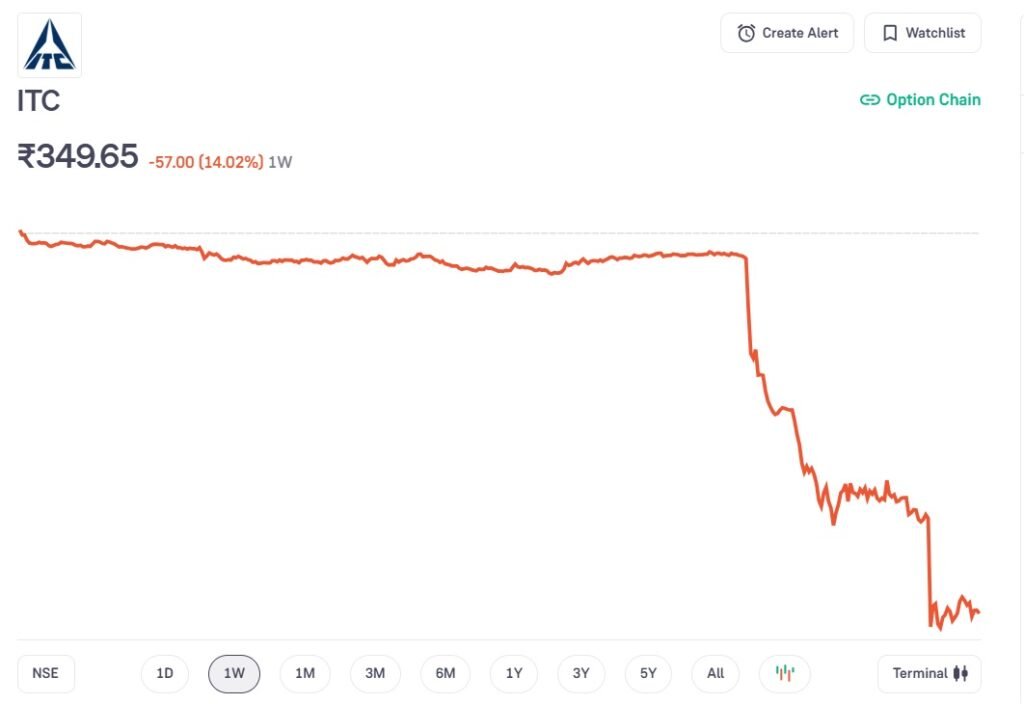
Market Reaction: Sharp Stock Declines and Downgrades
The market reaction was swift. ITC’s share price suffered broad declines, hitting fresh 52-week lows and wiping out significant market value. Brokers and analysts pointed to the excise duty hike as a principal catalyst for the sell-off, triggering revisions to earnings forecasts and investor sentiment.
Among the early responses:
- PhillipCapital downgraded ITC from Buy to Reduce, slashing its target price from ₹528 to ₹348, and warned that steep excise hikes could lead to a 12.5% decline in cigarette volumes in FY27.
- Nuvama Institutional Equities cut its rating from Buy to Hold and trimmed its target to ₹415 from ₹534, highlighting heightened taxation and pricing pressures.
- Emkay downgraded ITC from Add to Reduce and brought its target down to ₹350, characterising the tax move as a “fiscal bombshell” and forecasting significant price hikes across cigarette categories.
- Motilal Oswal shifted its call to Neutral from Buy with a reduced target of ₹400, noting that valuation multiples could reset under the higher-tax regime.
- Some brokerages, including B&K Securities and Antique Stock Broking, maintained Buy ratings but still implemented meaningful target cuts, reflecting near-term uncertainty.
Excise Duty Hike: Details and Financial Implications
The Government of India’s revised excise structure, effective February 1, 2026, levies higher specific duties on cigarettes across categories, ranging between ₹2,050 and ₹8,500 per 1,000 sticks based on product length. This is in addition to the existing 40% Goods and Services Tax (GST) already applied to tobacco products.
Brokerages estimate that, to pass on the full tax burden to consumers, retail prices may need to rise by as much as 23–50%, depending on the cigarette segment. This has raised concerns about consumer down-trading to lower-priced alternatives, erosion of volumes, and the potential growth of illicit consumption in response to higher retail prices.
Volume and Earnings Pressure Forecast
Analysts are revising earnings forecasts downward for ITC’s cigarette business:
- PhillipCapital forecasts a 12.5% volume decline in FY27 with only moderate recovery anticipated in FY28.
- DAM Capital anticipates a roughly 7% volume de-growth in FY27 and significant consumer price increases.
- Nuvama has projected a broader impact on EBITDA and expects year-on-year declines in both EBITDA and volumes if elevated pricing dampens demand.
Despite near-term pressure, some brokerages remain cautiously optimistic about ITC’s diversified revenue streams, including its non-tobacco FMCG and paperboard segments, which could offer resilience as cigarette volumes adjust.
Investor Sentiment and Broader Market Impact
The industry-wide negative sentiment extended beyond ITC. Tobacco and cigarette stocks, including peers such as Godfrey Phillips India, also experienced significant selling pressure, contributing to a broader drag on the FMCG segment.
The sell-off has prompted investors to re-evaluate their exposure to the cigarette segment, especially as taxes now form a larger portion of retail price structures without clear evidence that elevated pricing would be sustainable in volume terms.
Long-Term Outlook: Cautious Bullishness Amid Policy Headwinds
While the excise duty increase has introduced immediate challenges, several analysts maintain that ITC’s long-term fundamentals remain intact due to its market leadership, diversified business portfolio, and strong distribution network.
Nevertheless, near-term performance — particularly volume recovery and price pass-through effectiveness — will be key in shaping future earnings and equity valuations.
FAQs about ITC Stock
Why are brokerages downgrading ITC stock?
Brokerages downgraded ITC after a sharp cigarette excise duty hike raised concerns about higher prices, lower volumes, and near-term earnings pressure.
How does the excise duty hike affect ITC’s business?
The hike increases retail prices, which could reduce cigarette consumption, impact margins, and lead to down-trading or illicit sales.
Will ITC pass on the tax hike to consumers?
Analysts expect ITC to raise prices significantly to offset higher taxes, though full pass-through may affect demand.
Is ITC still a long-term investment?
Some analysts remain cautious but note that ITC’s diversified FMCG portfolio and strong balance sheet offer long-term stability.
Which segment of ITC is most impacted?
The cigarette segment, which contributes a major share of profits, is the most affected by the excise duty hike.
Also Read:
- Why 5StarsStocks.com Is Gaining Popularity Among Retail Investors
- Neelkanth invested 45000 for 3 years
- Adani Power Shares Rally 7%
Disclaimer: This article is for informational purposes only and does not constitute investment advice. Investors should consult a financial advisor before making investment decisions.
Feel free to Write for Us about Finance and Follow Us on: Twitter, Facebook, Instagram, Threads, and Whatsapp Group.